This guide ranks some of the biggest mosques in Nigeria based on their estimated worshipper capacity. While capacity figures can vary depending on whether a source counts only the main prayer hall, attached galleries, courtyards, and overflow areas used during Jumu’ah and Eid, the list below focuses on widely cited headline capacities that reflect each mosque’s role as a major congregational space in its city and region.
As a geographer, I find Nigeria’s largest mosques especially revealing—not only because of their scale, but because they are “urban landmarks” that tell stories about settlement patterns, migration, trade networks, and the religious geography of West Africa. A large mosque is rarely just a building. It functions as a node of movement (people arrive from many neighborhoods), a point of orientation within the city, and often a civic space where religious life intersects with education, mediation, philanthropy, and local governance.
In Nigeria’s diverse landscape—stretching from the humid coastal plains and lagoons of the south-west to the semi-arid Sahel-edge zones of the far north—mosque architecture also adapts to environment. Design choices such as shaded courtyards, ventilation strategies, roof geometry, and material selection respond to heat, dust, rainfall intensity, and urban density. So when we compare Abuja, Kano, Lagos, Maiduguri, Ilorin, and Damaturu, we are also comparing different ecological zones, different historical pathways of Islam, and different urban forms.
Below is a summary table of the mosques discussed in this guide, followed by detailed profiles that explain what makes each site significant in Nigeria’s religious and cultural landscape.
| No | Name | Capacity | Location |
|---|---|---|---|
| 1 | Abuja National Mosque | 25,000 | Abuja |
| 2 | Yobe Central Mosque | 20,000 | Damaturu, Yobe |
| 3 | Ilorin Central Mosque | 20,000 | Ilorin, Kwara |
| 4 | Maiduguri Central Mosque | 15,000 | Maiduguri, Borno |
| 5 | Lagos Central Mosque | 10,000 | Lagos |
| 6 | Great Mosque of Kano | 10,000 | Kano |
How to Read This Ranking (A Geographer’s Note on “Capacity”)
Before we examine each mosque, it helps to clarify what “capacity” can mean in practical terms. Capacity figures for major mosques are often communicated as rounded estimates rather than fixed numbers, because the usable space changes with:
- Prayer type: daily prayers typically use a smaller portion of the complex than Jumu’ah (Friday congregational prayer).
- Season and weather: courtyards may be used differently during intense heat, rain, dust storms, or harmattan haze.
- Festival periods: Eid prayers can expand into courtyards and adjacent open spaces, temporarily increasing capacity.
- Circulation and safety planning: crowd management strategies, entry points, and emergency routes can affect how many people can safely occupy a site.
So, this guide uses the commonly reported capacities as a useful comparative tool. The deeper story—the one a geographer cares about—is how each mosque functions as a major congregation point within its city, and how it reflects the urban form and cultural history of its region.
1. Abuja National Mosque – 25,000
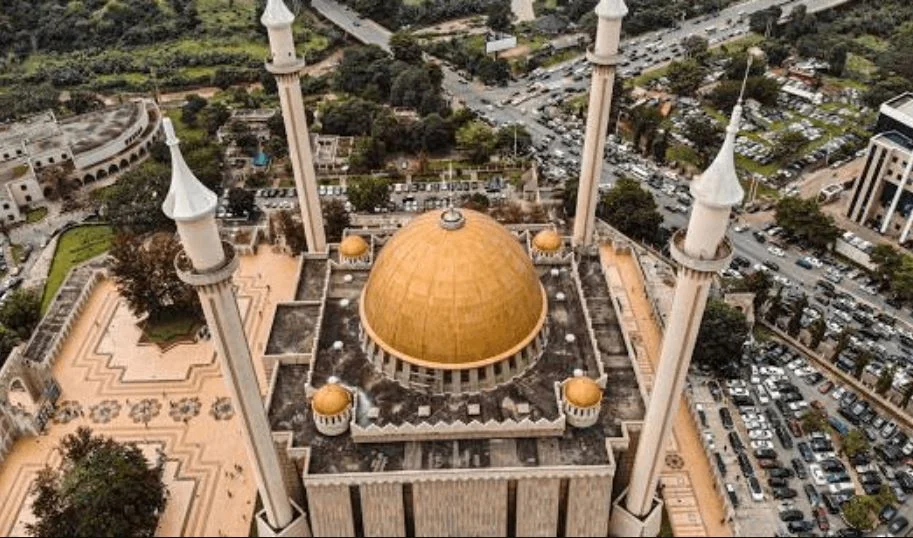
The Abuja National Mosque—often called the Nigerian National Mosque—is widely regarded as the largest mosque in Nigeria by capacity. It sits in Abuja, Nigeria’s capital, a planned city designed to function as a national meeting point across ethnic and religious lines. The mosque’s location on Independence Avenue, directly opposite the National Christian Centre, is more than coincidental. In the geography of symbols, this pairing expresses a deliberate spatial narrative: Nigeria as a multi-faith nation where major institutions occupy visible, central urban space.
Built in 1984 and opened in 1985, the mosque can accommodate about 25,000 worshippers. It is open to non-Muslims except during congregational prayers. From a tourism and civic geography perspective, this openness matters. It allows the mosque to function not only as a religious site but also as a landmark of national architecture and a point of curiosity for visitors seeking to understand Abuja’s civic landscape.
Beyond worship, the Abuja National Mosque contains supporting institutions—a library, a conference centre for about 600 people, and offices for the Islamic Centre. These features are common in major congregational mosques globally: they transform the site into a “knowledge and community hub” rather than a single-purpose building. In spatial terms, it becomes a multi-function node that draws people for learning, community coordination, and public events in addition to prayer.
Residential areas for imams and muazzins also exist within the mosque complex, reinforcing the idea that large mosques are not only visited spaces; they are also lived-in institutional environments with daily rhythms and responsibilities. The construction project was handled by Aims Construction Limited, while design consultancy came from AIM Consultants Ltd.
In 2017, major changes were made to the mosque’s management structure. The position of Chief Imam, vacant since 2015, was replaced by a Sole Administrator called the Murshid. Professor Shehu Ahmad Said Galadanci became the Murshid, combining the roles of Chief Imam and Administrative Head. He was assisted by three coequal Imams: Prof. Ibrahim Ahmad Maqari, Sheikh Ahmad Onilewura, and Dr. Muhammad Kabir Adam.
On December 2, 2024, Dr. Abdulkadir Salman Jummu’ah Solagberu was appointed Chief Imam of the mosque, with approval from the Nigerian Supreme Council for Islamic Affairs. Leadership shifts like these are not only religious matters; they also shape how the mosque connects with communities, coordinates educational activity, and manages public engagement in a capital city that is a national crossroads.
Geographic significance: Abuja’s role as the national capital strengthens the Abuja National Mosque’s status as a “national” mosque. It draws worshippers from multiple states, diplomats, civil servants, business travellers, and residents across the city’s expanding districts. The mosque’s scale and central location reflect Abuja’s planned identity as a city of national unity and institutional visibility.
2. Yobe Central Mosque – 20,000
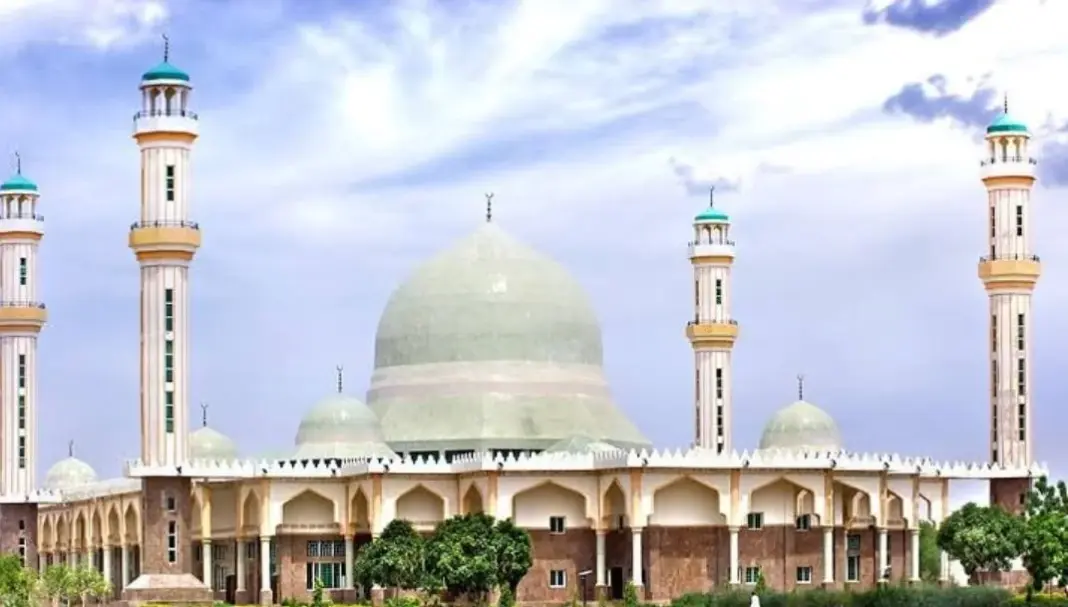
The Yobe Central Mosque is located in Damaturu, the capital of Yobe State, and is often cited as one of Nigeria’s largest mosques with a capacity of over 20,000 worshippers. Its scale is especially noteworthy when we consider Damaturu’s role as a state capital in the north-east. Here, the mosque functions as both a central religious gathering space and a civic landmark, shaping the city’s identity and skyline.
Completed in May 2007, the mosque’s construction experienced delays tied to political changes and a military coup. The project was initiated by Governor Bukar Abba Ibrahim and reportedly cost over one billion naira. While budgets and timelines are often debated in public projects, the completion itself reflects a key geographic reality: major religious buildings in Nigeria frequently serve as long-term civic investments that unfold across political cycles.
Architecturally, the mosque blends traditional Islamic design with modern building methods. Its tall minarets, large prayer halls, and expansive internal space accommodate the peaks of religious activity, particularly during Eid. The exterior features decorative carvings and calligraphy, while the interior emphasizes space, flow, and congregation—core functional needs for a mosque designed for thousands.
Yobe Central Mosque also supports educational programs and contributes to community cohesion. In many northern Nigerian cities, central mosques are closely linked to religious education and to informal mediation networks that support social peace. A large mosque thus becomes a stabilizing social institution, not merely a structure.
Geographic significance: Damaturu lies within Nigeria’s north-eastern zone, a region shaped by long-distance movement routes and historic connections to Sahelian Islamic scholarship and trade. A major central mosque reflects that cultural geography, and its capacity indicates its role as a primary congregation point for the city and its surrounding settlements.
3. Ilorin Central Mosque – 20,000
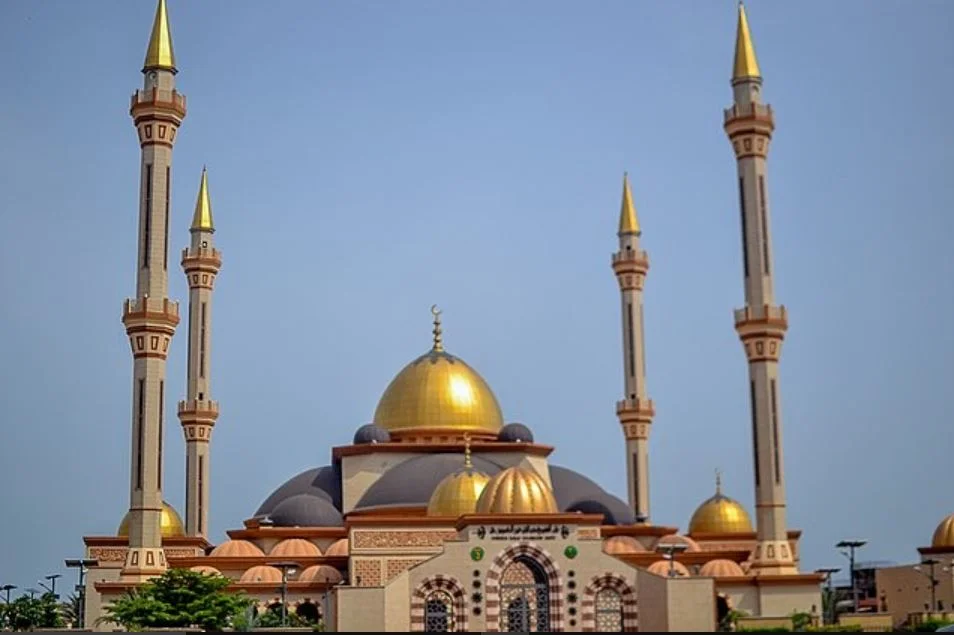
The Ilorin Central Mosque, located in Ilorin, Kwara State, is widely celebrated not only for its size (about 20,000 capacity) but also for its architectural elegance. It is often described as one of the most visually impressive mosques in Nigeria, and it carries a deep historical narrative tied to Ilorin’s identity as a city situated between cultural zones.
From a geographer’s perspective, Ilorin is a transition city—located near the interface of Nigeria’s south-west and the broader northern belt. This position has historically made it a meeting ground for languages, trade routes, religious institutions, and governance influences. The central mosque, in this context, reflects both religious continuity and the city’s role as a connector between regions.
The mosque’s history is traced back to around 1820, when an earlier mosque was built in the Agbarere area under Sheik Imam Muhammad Munab’bau. As Ilorin’s Muslim population expanded, the early mosques could no longer serve the scale of the growing congregation. In 1974, the ninth Emir of Ilorin, Alhaji Zulkarnaini Gambari, initiated construction of the current mosque. It was completed in 1981 and renovated in 2012 to improve both beauty and capacity.
The mosque’s design is said to be inspired by North African architecture, expressed through its pyramid-shaped structure, a large golden dome, and 99 smaller domes. Four tall minarets, each about 150 feet high, contribute to its skyline presence. Inside, Islamic calligraphy and marble finishes reinforce the sense of sacred space and artistic continuity.
The mosque also functions as a community institution by hosting educational programs, promoting Islamic studies, and offering social support. In Nigeria, a central mosque often operates as a place of religious instruction, civic gathering, and community organization—especially in cities with long histories of scholarship.
Geographic significance: Ilorin’s position as a cultural crossroads helps explain why its central mosque carries both architectural ambition and large capacity. It serves a congregation shaped by urban growth, educational networks, and regional movement patterns.
4. Maiduguri Central Mosque – 15,000
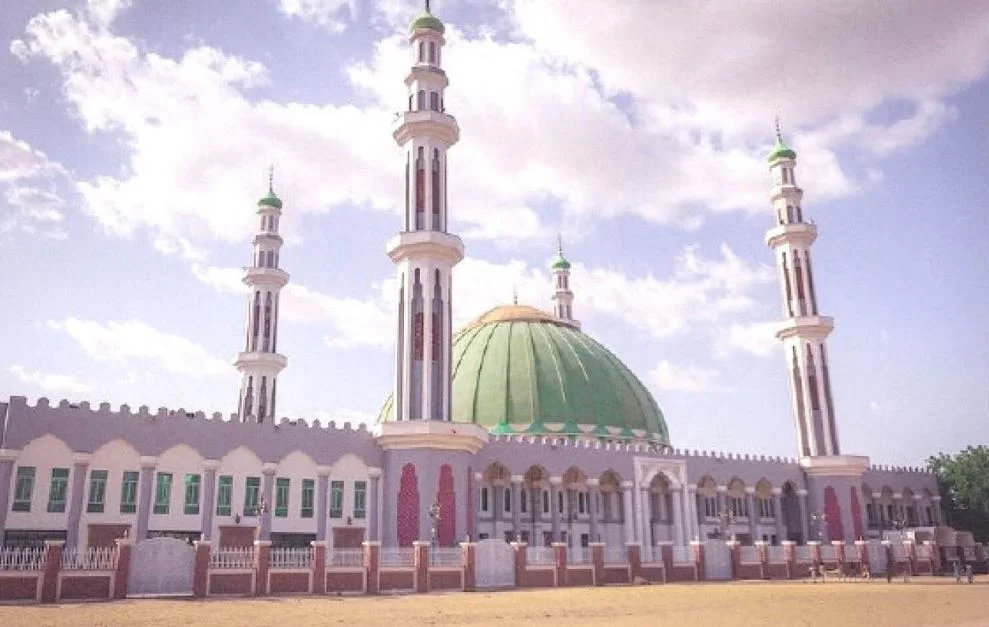
The Maiduguri Central Mosque, located in Borno State, is a major congregational landmark in north-eastern Nigeria with an estimated capacity of 15,000 worshippers. The mosque’s history reflects both continuity and long reconstruction timelines. Originally built in 1918, it was renovated and expanded over time. In 1986, it was demolished to allow major upgrades, but construction faced delays and challenges that stretched for decades—reported as lasting about 33 years.
Projects that extend over such long periods often become surrounded by public narratives—some interpret delays as administrative problems, others see deeper social meanings. Some believed the project was jinxed. In the end, what matters is that the structure was completed through renewed political will and institutional support. Former Governor Kashim Shettima revived the project, and the mosque was completed in 2019. It was officially opened on February 8, 2019, by the Sultan of Sokoto.
The mosque is known for its Islamic architectural features, including domes and minarets, but also for its modern functional facilities: classrooms, libraries, a media center, ablution points, water reservoirs, restroom facilities, and backup power systems. These additions are significant because they show how a modern central mosque is expected to serve more than prayer. It becomes a social infrastructure space—supporting learning, communication, and community coordination.
Geographic significance: Maiduguri sits within a region shaped by borderland movement, historical Sahel connections, and complex security and humanitarian realities in recent decades. Central institutions, including large mosques, often serve as community anchors during periods of social stress—providing continuity, gathering space, and social networks.
5. Lagos Central Mosque – 10,000
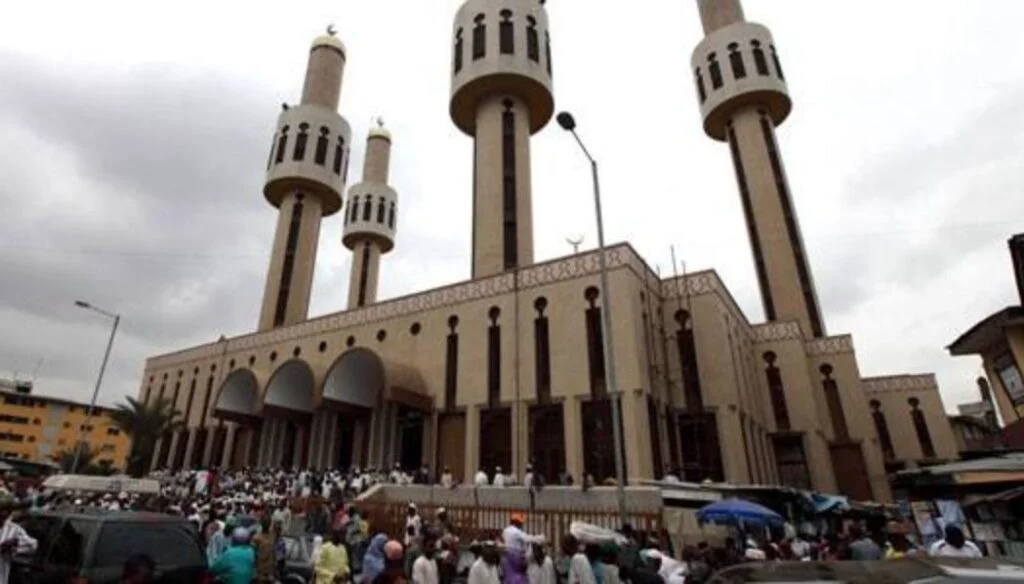
The Lagos Central Mosque is one of Nigeria’s largest and oldest mosques, located at 46A Nnamdi Azikiwe Street, Lagos Island. It holds about 10,000 worshippers. While its capacity is smaller than Abuja’s or Ilorin’s, its geographic significance is enormous because Lagos is Nigeria’s largest city and its leading commercial and maritime hub. In a city of this density, building a large central mosque is not only a religious achievement—it is also an urban planning statement, negotiating limited space, intense traffic flows, and a constantly changing cityscape.
The mosque was officially opened on May 28, 1988, but its roots trace back to the 18th century. Islam began growing in Lagos around 1775, linked to the efforts of Oba Adele I. The first mosque on the site was built in 1864 using mud and bamboo. In 1874, it was replaced by a stronger structure made of bricks and iron sheets. As the Muslim population grew, a larger mosque was built in 1913. By 1963, that mosque could no longer accommodate the congregation, leading to plans for a modern expansion.
The current mosque, completed in 1988, features four Ottoman-style minarets and a large prayer hall with a gold-plated dome. It also includes facilities such as a library, an Islamic center, and an assembly hall. These additions reflect a common pattern in major city mosques: they become integrated institutions within urban life, hosting learning, meetings, and community programs beyond prayer times.
Geographic significance: Lagos Central Mosque is embedded in the historic core of Lagos Island—an area long connected to coastal trade, colonial-era planning, and multi-ethnic settlement. Its history mirrors Lagos’s urban expansion and the growth of Islam as a visible part of the city’s cultural landscape.
6. Great Mosque Of Kano – 10,000
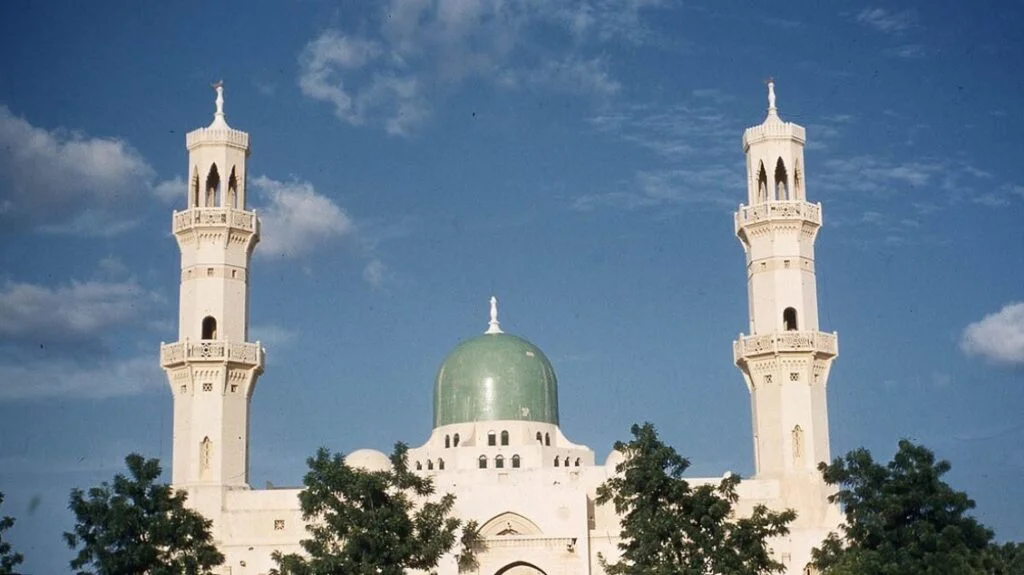
The Great Mosque of Kano—also known as the Kano Central Mosque—is one of Nigeria’s largest and oldest mosques, with an estimated capacity of about 10,000 worshippers. It is located in Kano, the capital of Kano State and one of Nigeria’s largest urban centers. Kano’s long-standing role as a commercial hub—historically linked to trans-Saharan trade networks—helps explain the deep institutional continuity of its central mosque.
The mosque is situated in the Mandawari area. Built in the 15th century for Muhammad Rumfa, the mosque was originally constructed with mud and a tower design. Before Rumfa’s reign and conversion to Islam, the central mosque was located elsewhere, possibly Sharifai or Yan Doya. The mosque was moved to its current location in 1582 by Muhammad Zaki and later rebuilt in the 19th century by Abdullahi Dan Dabo.
In the 1950s, the mosque was destroyed and rebuilt with support from the British, reflecting how colonial interventions sometimes reshaped city institutions and landscapes. The mosque has also witnessed major historical events, including the 1980 Kano riots, in which thousands died during conflict associated with a group called Maitatsine. These episodes underline that major religious spaces are also arenas of public life, where religious, political, and social tensions can surface.
Geographic significance: Kano’s central mosque is embedded within a historic urban fabric shaped by trade, scholarship, and governance. It is not merely a large building; it is part of Kano’s spatial identity as a city with deep Islamic heritage and long-distance commercial connections.
What These Mosques Reveal About Nigeria’s Cultural Geography
When we place these mosques on a mental map of Nigeria, a clear pattern emerges: the largest congregational mosques are concentrated in major capitals and historic trade cities. This is expected, because large religious institutions thrive where populations concentrate, where mobility networks bring people together, and where administrative and cultural authority tends to cluster.
Consider the distribution:
- Federal capital representation: Abuja National Mosque reflects national-level symbolism and institutional centrality.
- Historic northern urban heritage: Kano and Maiduguri reflect northern Islamic history, trade networks, and scholarly traditions.
- Transition-city identity: Ilorin reflects movement between cultural zones and a long history of Islamic institutions in the Middle Belt interface.
- Coastal metropolis density: Lagos Central Mosque reflects urban space constraints and the intense civic role of religious institutions in mega-cities.
- State capital centrality: Damaturu reflects the prominence of central mosques in state capitals as gathering points and community anchors.
From the viewpoint of cultural geography, these mosques also show how architectural styles travel. Ottoman-style influences appear in Lagos; North African inspiration is cited in Ilorin; Sahelian and Sudanic legacies shape northern mosque traditions; and modern national architectural language is prominent in Abuja. Nigeria’s mosque landscape is therefore both local and global: local in its community functions, global in its architectural references and the broader Islamic world connections.
Visitor Etiquette and Practical Guidance
Many of these mosques are active religious spaces rather than tourist monuments. If you plan to visit, especially as a non-worshipper, it is best to prioritize respect. In general:
- Dress modestly and follow local guidance on head coverings where required.
- Avoid visiting during peak prayer times unless you are participating in worship or have explicit permission.
- Ask before taking photographs, especially indoors or near worshippers.
- Follow security protocols in major city mosques, particularly in Abuja and northern capitals.
Respectful visits help these sites remain welcoming spaces and reduce friction between tourism curiosity and religious practice.
Conclusion
Nigeria’s largest mosques are not only defined by capacity; they are defined by the cities they serve, the histories they preserve, and the social functions they perform. From the Abuja National Mosque’s national symbolism to Kano’s deep historical continuity, from Lagos Island’s dense urban religious life to Ilorin’s architectural prominence, each mosque is a geographic landmark and a cultural institution.
Ranking mosques by capacity can be a helpful starting point, but the more revealing story is how these sites reflect Nigeria’s cultural geography: its trade histories, migration patterns, city growth, and the ways religion shapes urban landscapes. In that sense, each mosque is both a place of worship and a chapter in Nigeria’s spatial history.